


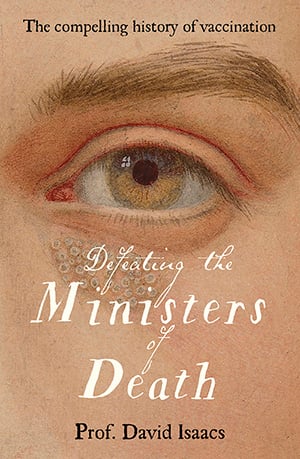
- Book Title: Defeating the Ministers of Death, The Compelling History of Vaccination
- Author: Prof David Isaacs
- Publisher: Harper Collins
- Reviewer: Dr Samantha Scherman, FRANZCOG
Defeating the Ministers of Death, written by Professor David Isaacs, was released in April 2019, at a time when the world was set to face the emergence of a pandemic (COVID-19) that would raise questions across the globe surrounding vaccine development, efficacy, and safety.
Professor Isaacs, who sadly passed away in August of this year, was an esteemed Australian paediatrician, who trained at Cambridge and Oxford, before heading the first department of infectious diseases at the Royal Alexandra Hospital for Children in Camperdown, Sydney (now known as the Children’s Hospital at Westmead).
Although Defeating the Ministers of Death describes the scientific discoveries and technologies that led to the development of modern-day vaccines, it is by no means a ‘dry’ scientific tome. In his introduction, Professor Isaacs states that the ‘history of the development of vaccines by great scientists and doctors is one full of human interest, drama and magic,’ and that in his book he wished to ‘explore that human dimension.’
There are chapters within the book dedicated to some of the most feared diseases in human history, such as smallpox, polio, tuberculosis, diphtheria, rabies, and tetanus, many of which have plagued the world for thousands of years and have been documented in ancient texts. Other chapters discuss the anticancer benefits of vaccines (such as the modern-day HPV vaccines), vaccines in pregnancy, vaccines for the elderly, the ethics around immunisation and the modern-day anti-immunisation movement. There is also a chapter dedicated to the tragedies that occurred in the early days of immunisation, where some lives were lost rather than saved through immunisation because of issues with the way early vaccines were developed and manufactured.
Professor Isaacs intersperses his scientific explanations regarding vaccine development with some humorous references to old age remedies for certain infections. For example, the remedy for chickenpox in County Down, Ireland, in the 19th century included ‘two kinds of food obtained from two first cousins who are married and soup made from the tails of mice.’ The combination of such humorous anecdotes with the tragic tales of the millions of humans permanently disabled or deceased from infections across human history do indeed lend a very ‘human dimension’ to this book.
The first chapter, entitled ‘Our deadliest foes,’ starts with the incredibly sad story of the children of President Abraham Lincoln. The President and his wife, Mary, lost their 3-year-old son, Eddie, to a several weeks long illness of coughing and fevers, likely either diphtheria or tuberculosis. Eleven years later, their 11-year-old son, Willie, died from typhoid. Nine years later, their 18-year-old son, Tad, died from heart failure, possibly related to tuberculosis. Only one of their four children survived to adulthood, and of course Mary also had to cope with the death of her husband by shooting three years after Willie passed away.
The tragic loss of so many of your children to infectious illnesses seems almost inconceivable to those of us living here in modern day Australia, though prior to the development of vaccines and antibiotics, this was all too much of a reality for families, and unfortunately remains a reality for poorer nations where widespread vaccination and antibiotic use remains out of reach for many.
I found the chapters on vaccines in pregnancy and anticancer vaccines to be most relevant to our specialty. I was fascinated to learn from the book, that somewhat embarrassingly for obstetricians, the link between German measles infection in mothers and congenital rubella syndrome was not made by an obstetrician, or even a paediatrician, but during the Second World War by an Australian ophthalmologist called Sir Norman McAlister Gregg. According to Professor Isaacs, in 1941, Gregg started to see a large number of newborns with eye defects, particularly cataracts. He then overheard two mothers in his waiting room discussing the fact that they had both had German measles early in their pregnancies, associated with an outbreak of the infection in Sydney at that time. His medical curiosity piqued, he enquired with his colleagues as to whether they too had noticed an increase in affected newborns in their practices, and he identified 78 babies. 68 of the mothers of these babies remembered having a rubella-like illness in early pregnancy. He was, perhaps, the first person to recognise that organisms infecting a pregnant woman could cross the placenta and harm the fetus.
My father grew up in a small village in rural Canada in the 1940s and 1950s. He still remembers the fear that would sweep through the community when a polio outbreak occurred. Professor Isaac’s book is not only an enjoyable and interesting read, but also a testament to the tenacity and research capabilities of those doctors and scientists who have been involved in vaccine development over the years, and to the millions of lives that have been saved across the world through vaccination.
Defeating the Ministers of Death is available in all good bookstores.

Leave a Reply